
Zain Sardar on Einstein’s Socialism
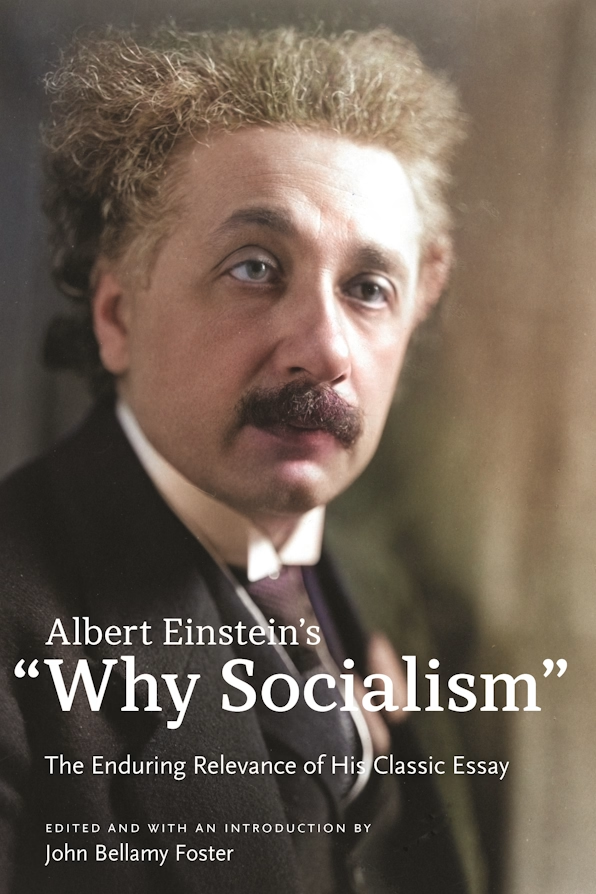
Why Socialism?: The Enduring Relevance of His Classic Essay ed. John Bellamy Foster published by Monthly Review Press
Critically acclaimed biographies of Albert Einstein, such as Walter Isaacson’s, have foregrounded his rebelliousness and readiness to challenge mainstream thinking and conventions. These were qualities that established his renown as an iconic figure in his lifetime. However, his political radicalism, expressed through enduring commitment to socialist ideals, has been deliberately downplayed and even erased in the commentaries of his life and times. John Bellamy Foster’s edited edition of Why Socialism? which centres Einstein’s classic essay written for the inaugural issue of the Marxist journal Monthly Review, is therefore a much-needed corrective.
As Bellamy Foster points out, Einstein’s celebrity status afforded him a high degree of protection. He was relatively free, despite FBI surveillance in his later years, to exhibit his radical credentials and champion an array of progressive causes, including the advancement of civil rights. Nonetheless, his audacity was no less astonishing, attested to by the principled stances he took in the service of marginalised communities and on “behalf of common humanity”.
The period of his life spent in Germany during the first world war and the rise of the Nazis only strengthened his belief in pacificism and his disgust against nationalism (even his avowed Zionism is more complex and qualified than many on the Left may think) and reactionary tendencies of all varieties. Post second world war, despite the toxic miasma of McCarthyism and virulent anti-socialist sentiments pervading the US, he held firm to his conviction that a socialist alternative was necessary. Einstein’s interventions in American politics, as well as his mission to establish a new university based on inclusive and democratic principles, belies any suggestion that his political views were merely rhetorical.
The man whose “miracle year” while working in a Swiss patent office transformed our understanding of the cosmos — as is strongly implied in the opening lines of his essay — clearly saw that revolutions in science and technology could only positively shape the future of humanity if accompanied by social and economic transformation. The gains of science could only fully benefit society in a political system that curbs the senseless waste of capitalism — generated by the conditions of “egoism, individualism, and the social consequences of competition to the spirit of humanity”.
Einstein’s essay remains a concise and powerful expression that while the “high priests” of science can make scintillating deductions and discoveries; humanity’s biggest project remains to liberate ourselves from the servitude of socio-economic systems that pit us against each other. This is a project for which no specialist knowledge is required.
For drawing our attention to this work, we ought to be grateful to Bellamy Foster.